Master’s in Speech-Language Pathology
Speech-language pathologists (SLPs) work with diverse patients in a variety of capacities, including administration, advocacy, direct care, education, and research. Once you have completed your bachelor’s degree in speech-language pathology or another relevant field, the next step is to pursue your master’s degree in speech-language pathology. Speech pathologist degrees at the master’s level will provide you with comprehensive coursework, clinical experience, and more.
Becoming an SLP starts with a degree in speech pathology or communication sciences. Take the first step. Request information from these schools to learn more.
The path to becoming a speech-language pathologist typically takes 6-7 years: four years for your bachelor’s degree and 2-3 years for your master’s program. After graduation, you’ll complete a clinical fellowship year and pursue your CCC-SLP certification, the gold-standard credential recognized across all practice settings.
Online Speech-Language Pathology Programs
Many institutions now offer online speech pathology programs, either partially or fully online. These distance-based programs allow students to complete the academic components of their SLP master’s program through interactive online study, then fulfill clinical requirements at approved sites close to home.
Online SLP programs must meet the same CAA accreditation standards as campus-based programs. That means graduates of online speech language pathology programs qualify for the same ASHA certification, Praxis examination, and state licensure as students who attended in person. The clinical hours requirement—400+ supervised clock hours—is completed in person regardless of how coursework is delivered.
Hybrid formats are the most common structure for online SLP master’s programs. Coursework is delivered remotely, while clinical placements are arranged locally through your program’s network of approved supervisors. Fully asynchronous online SLP programs are less common but available through select institutions.
States with the highest concentration of online and hybrid options include California, Texas, Florida, New York, and Pennsylvania. Browse our CAA-accredited program directory and filter by online availability to find options in your state.
- Emerson College - Master's in Speech-Language Pathology online - Prepare to become an SLP in as few as 20 months. No GRE required. Scholarships available.
- Arizona State University - Online - Online Bachelor of Science in Speech and Hearing Science - Designed to prepare graduates to work in behavioral health settings or transition to graduate programs in speech-language pathology and audiology.
- Pepperdine University - Embark on a transformative professional and personal journey in the online Master of Science in Speech-Language Pathology program from Pepperdine University. Our program brings together rigorous academics, research-driven faculty teaching, and robust clinical experiences, all wrapped within our Christian mission to serve our communities and improve the lives of others.
- Aurora University - BS Communication Sciences and Disorders program - Discover how to transform lives by identifying and treating communication disorders for people of all ages. You’ll gain hands-on experience while fulfilling requirements toward graduate education.
- Arkansas State University - Dyslexia Certificate - Build upon your teaching expertise by adding a specialization in dyslexia with their Dyslexia Certificate online program.
- Eastern Oregon University - Master of Science in Education with a specialization in Dyslexia - Provides an advanced study of best practices and applications for PK–12 contexts with a specialization in Dyslexia.
- The University of West Alabama - Master of Education in Dyslexia Therapy - Enter an emerging field to support students with dyslexia and related reading challenges by earning your MEd in Dyslexia Therapy degree.
Why Trust Our SLP Program Directory?
ASHA-Accredited Programs
Every program in our directory is verified for CAA (Council on Academic Accreditation) accreditation, ensuring you’re considering only programs that meet ASHA’s rigorous standards.
Current Salary Data
Our salary information comes directly from the U.S. Bureau of Labor Statistics, updated annually with 2024 data covering national, state, and metropolitan area statistics.
Complete State Licensing Guides
Up-to-date licensing requirements for all 50 states plus D.C., including education requirements, clinical hours, examination details, and continuing education obligations.
Expert-Reviewed Content
Our resources are reviewed by practicing speech-language pathologists and updated regularly to reflect changes in ASHA guidelines, state regulations, and program offerings.
Doctor of Philosophy (Ph.D.) in Speech-Language Pathology
If you have always dreamt of a career in academia, a Ph.D. in SLP might be for you. A speech pathologist degree at the research-doctorate or clinical-doctorate level allows you to continue your education while helping to educate others as well.
Speech-Language Pathology Certification (CCC-SLP) and Licensure
Although it is not necessary in all states to earn speech-language pathology certification before practicing, earning your CCC-SLP serves as a mark of excellence in the SLP profession. Even in states that do not require the CCC-SLP, this speech-language pathology certification is considered the gold-standard credential for SLPs in every practice setting. Each state maintains its own licensing requirements that may differ from ASHA’s certification standards.
Speech Language Pathology Careers
Wondering what you can do with a speech-language pathology degree? SLP careers include several different paths. Among the SLP career opportunities that await you include opportunities within education and hospital settings, non-profit organizations, and beyond.
- Forensic speech-language pathologist
- Fluency disorder specialist
- Multilingual speech-language pathologist
Career prospects for speech-language pathologists are strong, with median salaries exceeding $84,000 and significant variation based on setting, specialization, and geographic location. Explore our comprehensive SLP salary guide to understand earning potential in your state.
Are You Ready to Become a Speech-Language Pathologist?
When selecting a program, you’ll want to compare factors like accreditation status, clinical placement opportunities, online vs. on-campus formats, tuition costs, and program length. Our comprehensive program comparison tool helps you evaluate options and make an informed decision.
Earning your speech pathologist degree can jump-start a lifelong, rewarding career as an SLP as you work to improve people’s lives one therapy session at a time. Take the first step towards your master’s in speech pathology online or in-person today and learn how to become an SLP in your state below.
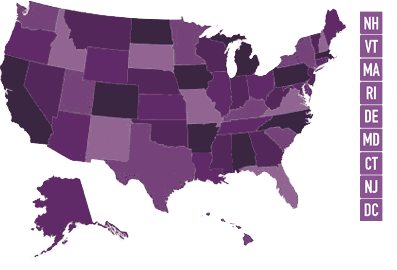
Find Speech Pathology Graduate Program Info For Your State
- Alabama
- Alaska
- Arizona
- Arkansas
- California
- Colorado
- Connecticut
- Delaware
- District of Columbia
- Florida
- Georgia
- Hawaii
- Idaho
- Illinois
- Indiana
- Iowa
- Kansas
- Kentucky
- Louisiana
- Maine
- Maryland
- Massachusetts
- Michigan
- Minnesota
- Mississippi
- Missouri
- Montana
- Nebraska
- Nevada
- New Hampshire
- New Jersey
- New Mexico
- New York
- North Carolina
- North Dakota
- Ohio
- Oklahoma
- Oregon
- Pennsylvania
- Rhode Island
- South Carolina
- South Dakota
- Tennessee
- Texas
- Utah
- Vermont
- Virginia
- Washington
- West Virginia
- Wisconsin
- Wyoming